
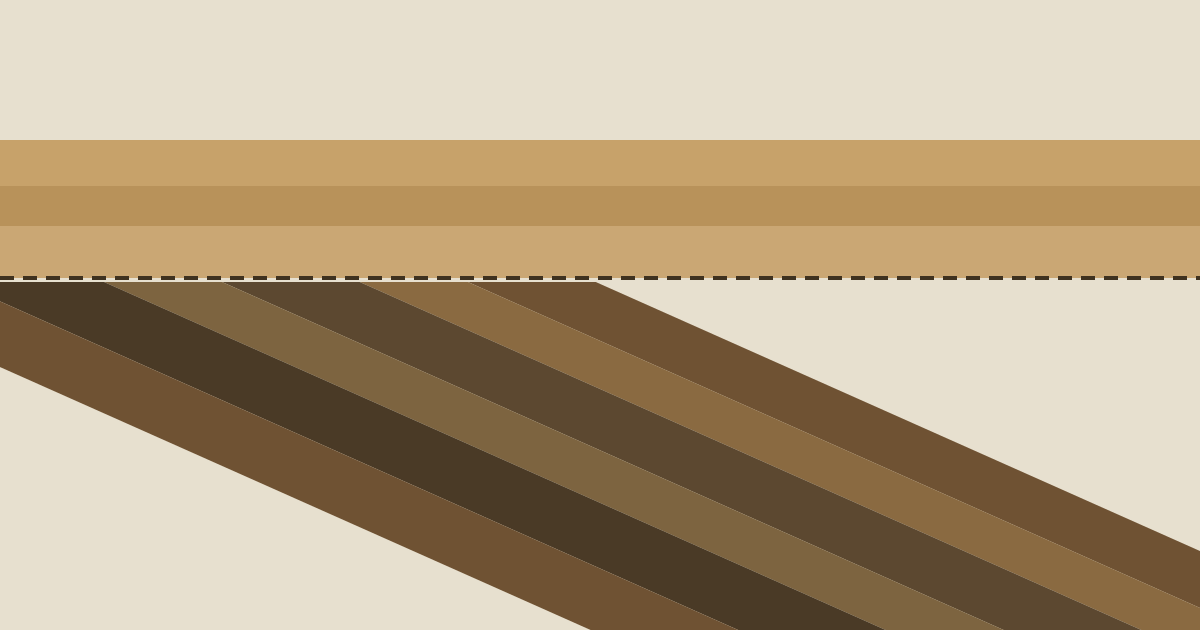
Missing time, not missing rock
We tend to picture a rock sequence as a continuous stack, each layer following smoothly from the one below. In reality, deposition is repeatedly interrupted. Sea level falls and the land is exposed to erosion; a region is uplifted and worn down; or the setting simply stops receiving sediment for a while. When deposition resumes, the new layers rest on an older surface across which time is unaccounted for. That surface is an unconformity, and the interval it represents is a hiatus.
The key idea is that an unconformity is a gap in time, marked by a physical surface in the rock. Reading it means working out how much time is missing and why.
The main kinds
Geologists recognise a few types, distinguished by what lies on either side of the gap:
- An angular unconformity separates tilted or folded older rocks from flatter younger beds laid across their eroded edges — clear evidence that the lower rocks were deformed and planed off before the upper ones arrived.
- A disconformity is a gap between parallel layers, where the older beds were exposed and eroded but not tilted; the break may be an uneven, channelled surface.
- A nonconformity places sedimentary rocks on top of eroded igneous or metamorphic basement — sediment laid over a long-buried, now-exhumed root.
- A paraconformity is the most cryptic: parallel beds with no obvious erosion surface, where the gap is revealed only by the fossils or ages jumping across a seemingly ordinary bedding plane.
The great Salt Range gap
Pakistan has a textbook example. In the Salt Range, Permian glacial and marine beds rest directly on Cambrian rocks, with the entire Ordovician, Silurian, Devonian and most of the Carboniferous missing beneath them — well over a hundred million years unrecorded. During that long interval the region stood above the sea, neither collecting sediment nor being buried, while elsewhere on Earth whole faunas rose and fell. The gap itself is the evidence of that emergence.
How gaps are detected
Some unconformities announce themselves — a sharp angular discordance, a scoured and channelled surface, a lag of pebbles or a fossil soil. Others are invisible to the eye and betrayed only by the fossils and ages on either side: when the faunal succession skips a stage, or a dated bed sits improbably close to a much older one, a hidden gap is implied. This is one reason biostratigraphy and precise dating matter so much — they measure the time that the rock alone does not show.
Why the silences matter
Unconformities are not failures of the record; they are part of it. Each marks an event — an uplift, a fall in sea level, a phase of erosion — and mapping them across a basin reveals the rhythm of its history. In a collisional setting like Pakistan’s, many gaps track the pulse of tectonics and changing sea level. To read stratigraphy well is to give the missing intervals the same attention as the layers, because in the gaps lies half the story.
See how ages and stages line up (and where they jump) on the time scale.